
Stop Making Grown Adults Earn Your Trust

Trust them on day one. Hold them to the standard every day after.
Over my career, I've worked for and alongside a lot of leaders. On the question of trust, almost all of them fall into one of two camps.
The first camp trusts people from day one, until someone gives them a reason not to. The second camp says trust has to be earned. Everyone starts at zero and works their way up.
I lean toward the first camp. Hiring grown adults and then making them spend six months proving they deserve to be treated like grown adults has always struck me as a strange way to build a team. But trust without accountability is half a picture, and I've watched plenty of trust-first leaders learn that the hard way.
Someone takes the flexibility and runs with it, straight out the door at 2:30 every afternoon. The leader feels betrayed, overcorrects, and by Monday everyone is filling out timesheets. The earn-it camp sees this happen and feels vindicated.
Both camps are having the wrong argument. Accountability without trust gives you compliance, which looks a lot like performance until your best people quietly leave. Trust without accountability gives you a culture that falls apart the first time someone tests it.
There's a better model, and it doesn't require picking a camp.
The internet had this argument recently
A leadership coach on TikTok posted two videos a few days apart.
The first said to stop making good employees earn basic trust. Give it to them on day one. If one person abuses the freedom, manage that person instead of writing a policy that punishes everyone else. Nearly 60,000 people watched it.
The second said that when flexibility turns into a lack of accountability, you aren't running a great culture, you're running a "poorly supervised daycare." That one passed 230,000 views.
On first read, the two videos contradict each other. On a second read, they're about two different things, and owners get into trouble when they treat them as the same thing.
Trust covers how people do the work. Accountability covers what they deliver and how they treat people.
The model: Trust First, Standards Always
The core rule:
Trust the method by default. Hold the standards without exception. Manage the individual, not the whole team.
The model has three zones.
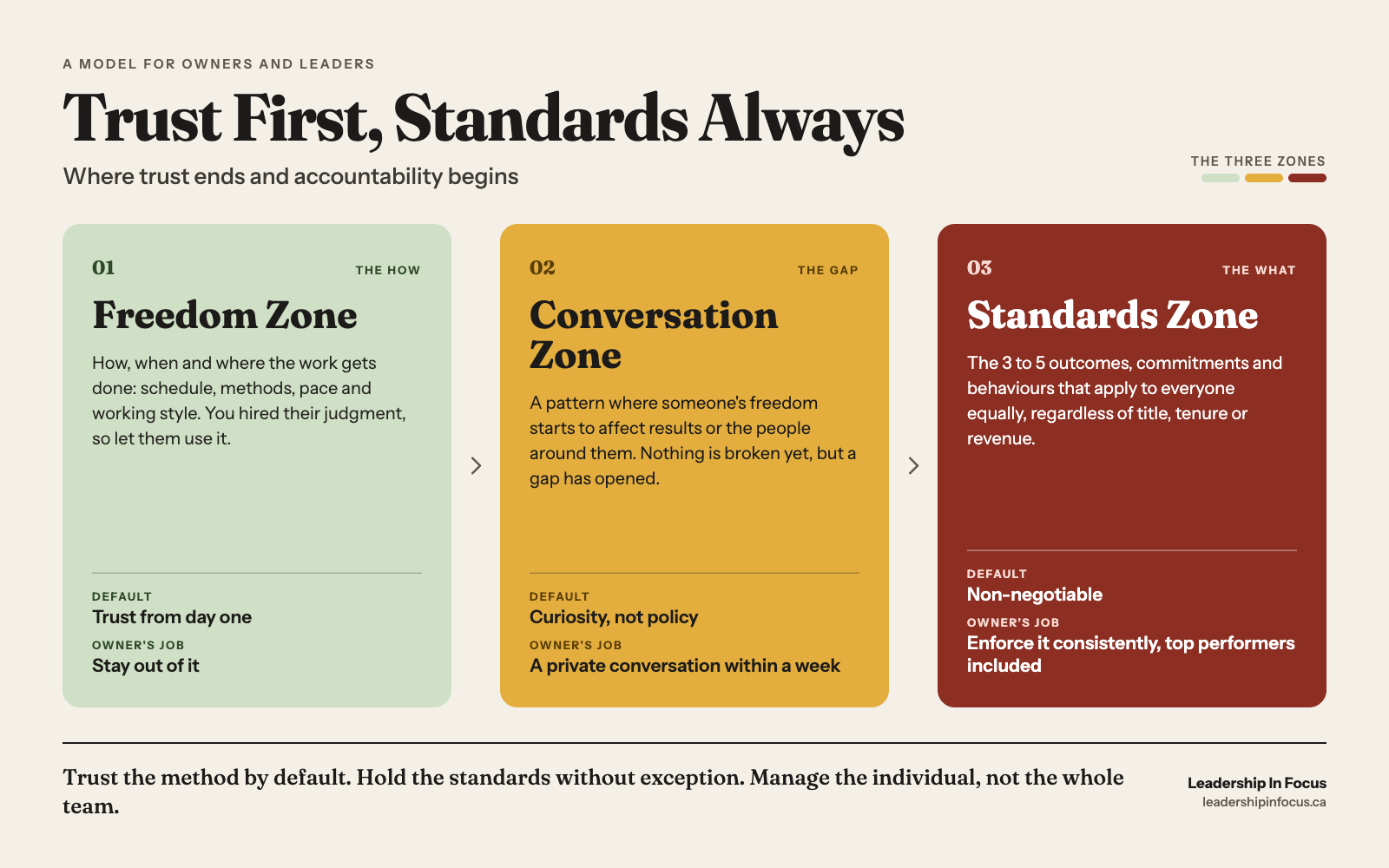
The Freedom Zone
Definition: Everything about how a person gets their work done: their schedule, methods, pace, working style, the occasional long lunch, and the phone on the desk.
In this zone, trust is given on day one, not earned. You hired this person for their judgment, so let them use it. If you're managing someone's lunch break, you're doing their job and not your own.
The Conversation Zone
Definition: The space where someone's use of their freedom begins to affect the results they owe or the people around them. Nothing has been violated yet, but a gap has opened between the freedom you gave and the standard you expect.
A missed deadline doesn't put someone here. A pattern of missed deadlines does, and so does a teammate who keeps quietly covering for them. The right response is a direct, private conversation. A new policy, a sigh in the team meeting, or hoping it resolves itself are all the wrong response.
This is where most owners get it wrong. Trust-first leaders tend to stay silent too long. Earn-it leaders tend to skip the conversation and go straight to the rulebook.
The Standards Zone
Definition: The small set of outcomes, commitments, and behaviours that apply to everyone on the team equally, regardless of title, tenure, or how much revenue they bring in.
Keep the list short. Three to five standards is about right. For example:
Deliver what you committed to, or raise it early if you can't.
Meet the quality bar on the work.
Treat customers and colleagues with respect.
Tell the truth, especially when it's inconvenient.
If you have twenty standards, you effectively have none, because nobody can remember twenty of anything and everyone knows you won't enforce them all.
Standards don't flex for your top performer. Once they do, you're running two rulebooks, and your whole team knows about both of them.
The Policy Trap
When one person abuses a freedom, owners or managers often respond by writing a rule for everyone. It's the office version of cancelling recess for the whole class because one kid threw sand.
Here's what the owner thinks happened, and what actually happened:
"I fixed the problem." The one problem person is still on the team.
"I set a clear standard." Twelve good people were punished for one person's behaviour.
"I avoided a confrontation." I postponed it, and the team noticed.
Rule of thumb: One person abusing a freedom calls for a conversation. Many people doing the same thing points to a system problem, and the system belongs to you.
Four questions before you act
Before you deal with any accountability issue, ask yourself:
Was the standard clear? If you can't write it in one sentence, the problem is the standard, not the person.
Is this one person or a pattern? If it's one person, handle it with them. If it's several people, look at the system first, then at yourself.
Would I handle it the same way with my best performer? If not, you've found your second rulebook.
Have I actually said it out loud to them? Hinting, sighing, and updating the handbook don't count.
The escalation ladder
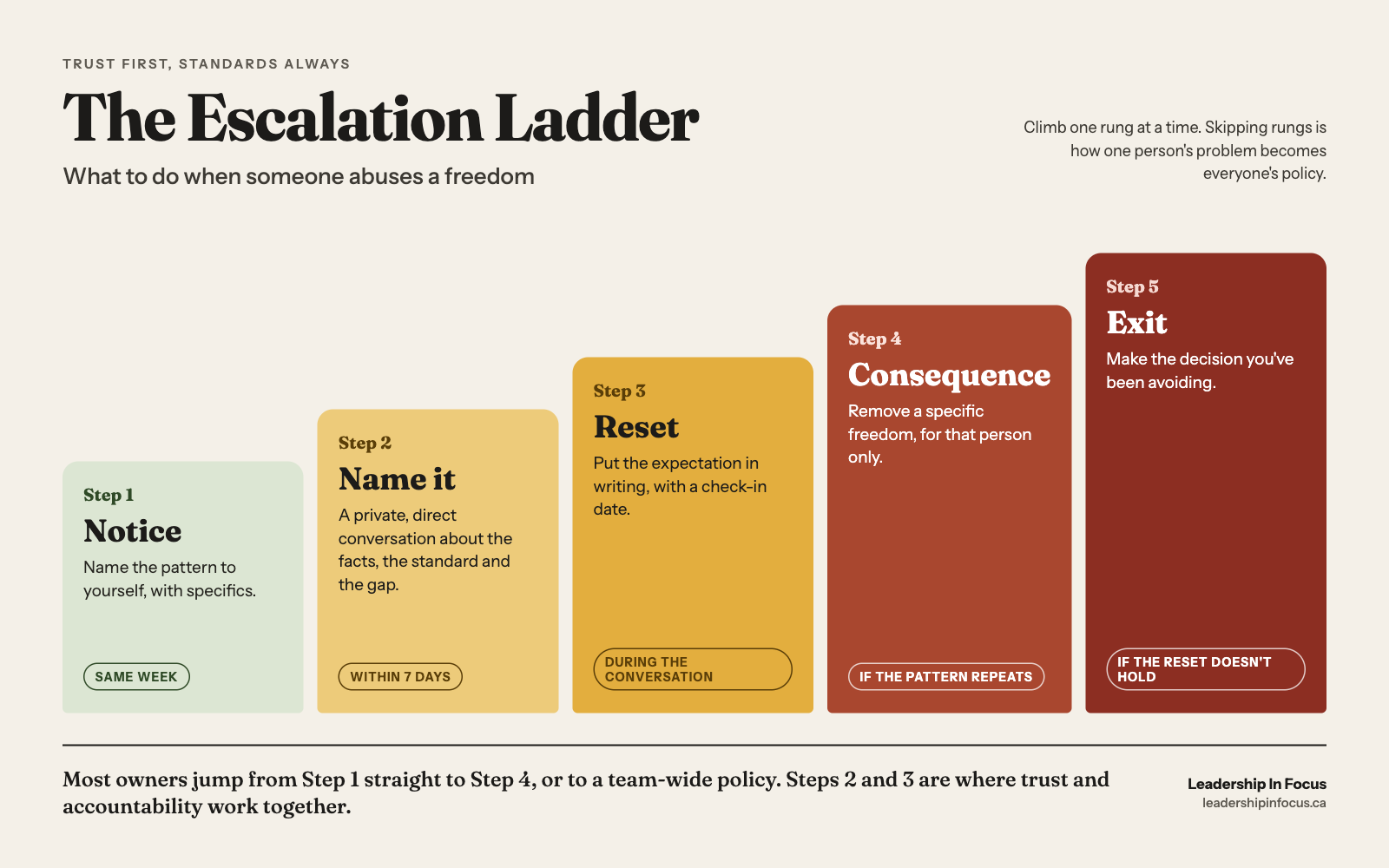
Notice. Name the pattern to yourself, with specifics. (Same week)
Name it. Have a private, direct conversation covering the facts, the standard, and the gap. (Within 7 days)
Reset. Put the expectation in writing and set a check-in date. (During the conversation)
Consequence. Remove a specific freedom, for that person only. (If the pattern repeats)
Exit. Make the decision you've been avoiding. (If the reset doesn't hold)
Most owners or managers tend to jump from step 1 straight to step 4, or from step 1 to a team-wide policy. Steps 2 and 3 are where trust and accountability get to work together.
The five-question owner self-audit
Answer yes or no:
Do I have a team-wide rule that exists because of one person?
Is there a high performer whose behaviour I routinely excuse?
Could everyone on my team name our non-negotiable standards without looking them up?
Have I skipped a step-2 conversation in the last 90 days?
Does my team trust me enough to tell me when I'm the problem?
Picking a side isn't required
The trust-first camp is right about where to start. The earn-it camp is right that standards have to mean something. You don't have to choose between them. Trust people with how they do the work, hold everyone to the same standards, and have the conversation before you write the rule.
Stop making grown adults earn your trust. Give it to them on day one, and hold them to the standard every day after.
As for question five in the audit: if your honest answer is "probably not," that's a different conversation, and it's probably the one to have first.
