
Why Are Problems Becoming Surprises?
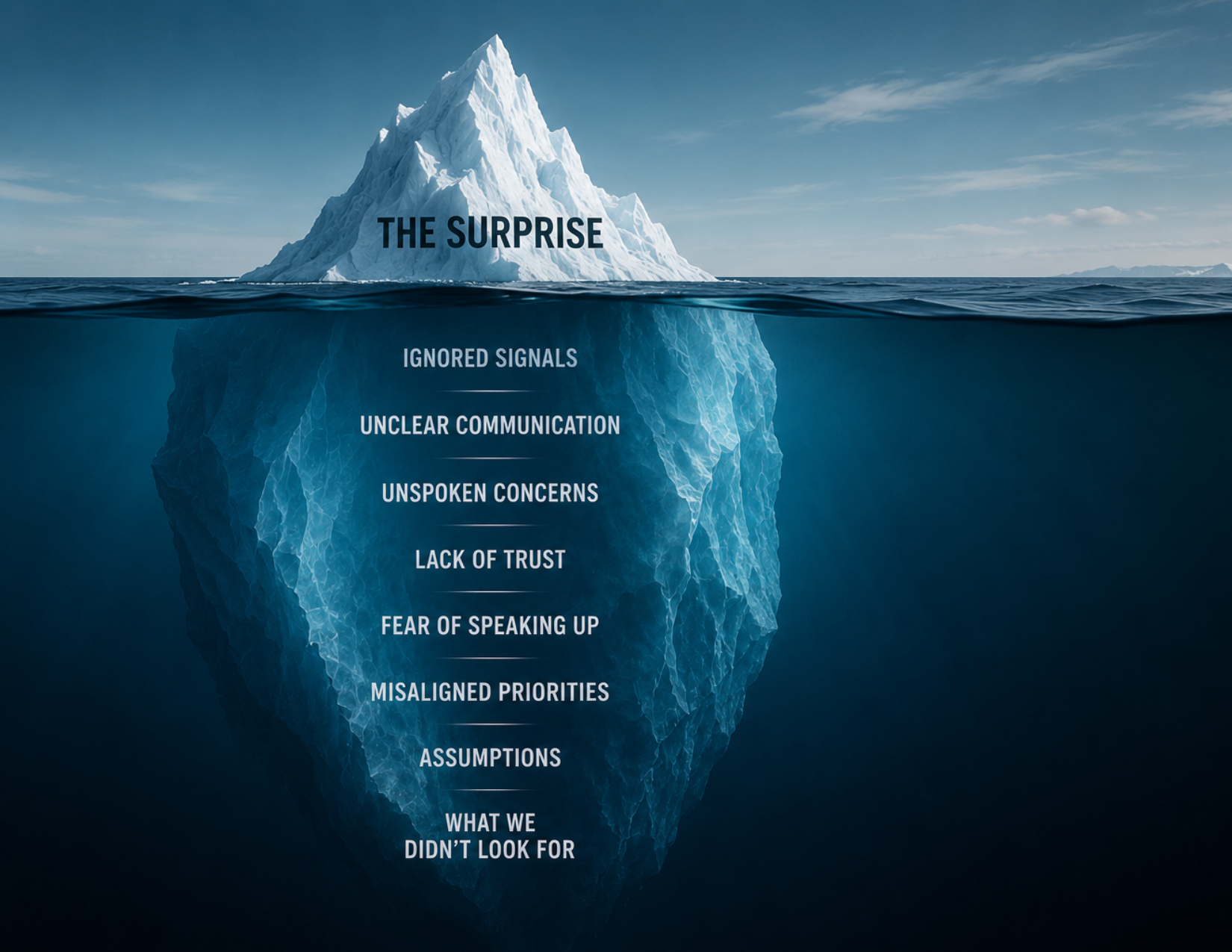
By definition, a surprise is something you didn't see coming. But in most organizations, that's not actually true. The problem was visible. It just wasn't visible to you, in a form you could act on, in time to do anything about it.
Researchers at MIT Sloan surveyed 140 corporate strategists and found that two-thirds of them admitted their organization had been blindsided by as many as three high-impact competitive events in the previous five years. The follow-up finding is the one that should stop you mid-scroll: 97% of those same respondents said their company had no early warning system in place to prevent it from happening again. The surprises weren't random. They were the predictable output of organizations that had no mechanism for catching trouble before it became a headline.
This isn't a hypothetical risk to leadership careers, either. A separate study examining why boards fire CEOs found that 23% of those terminations were attributed to "denying reality,” not a strategic misstep, not a market shift nobody could have predicted, but a documented unwillingness or inability to see what was already happening inside the business. Nearly a quarter of CEO firings, traced back to the same root cause: information existed, and it didn't reach the decision-maker in a usable way.
So where does it go? It gets filtered, one layer at a time, by people with a rational incentive to make their piece of the business look manageable. A direct report softens a risk into a "watch item." Their manager rolls four watch items into a single line that says "on track, minor headwinds." By the time it reaches you, the specific, urgent thing that someone flagged six weeks ago has been quietly translated into a sentence that sounds like nothing. Nobody lied. Everybody just optimized for not being the bearer of bad news, and the truth dissolved a little at every handoff.
This is why "surprises" almost always trace back to a failure of structure, not a failure of intelligence. Smart, experienced leaders get blindsided constantly, because they were looking at a version of reality that had already been pre-approved for their consumption.
It's the exact problem Ford was living inside before Alan Mulally took over. Every Thursday, the Business Plan Review meeting Mulally implemented, ran through the same colour-coded slides, and every slide came back green, while the company hemorrhaged billions of dollars in plain sight.
The information that would have prevented the surprise wasn't missing. It was sitting in someone's notes, in someone's gut feeling, in someone's hesitation to be the one who said it out loud in front of the room. Mulally's entire intervention was building a structure where that hesitation no longer made sense, where surfacing a real problem early was rewarded instead of punished.
That's the actual fix, and it's the starting point of Face Reality, the first principle in the BrandTruth Alignment™ System: you don't prevent surprises by getting smarter or more vigilant. You prevent them by building the kind of structure where the truth doesn't have to survive six layers of translation to reach you.
If you want a quick gut check, ask yourself this: what's the most recent piece of bad news that reached you in its original, unfiltered form, exactly as the person who first noticed it would have said it? If you're struggling to answer, the surprises aren't coming. They're already on their way.
If your organization keeps getting blindsided by things that, in hindsight, someone probably saw coming, that's not bad luck. It's a structure problem, and it's fixable.
At Leadership In Focus, we help leadership teams build the kind of visibility that catches the next problem before it becomes a surprise. Reach out to us at contact@leadershipinfocus.ca to talk through what that could look like for your organization.
