
What Should Leaders Stop Doing?
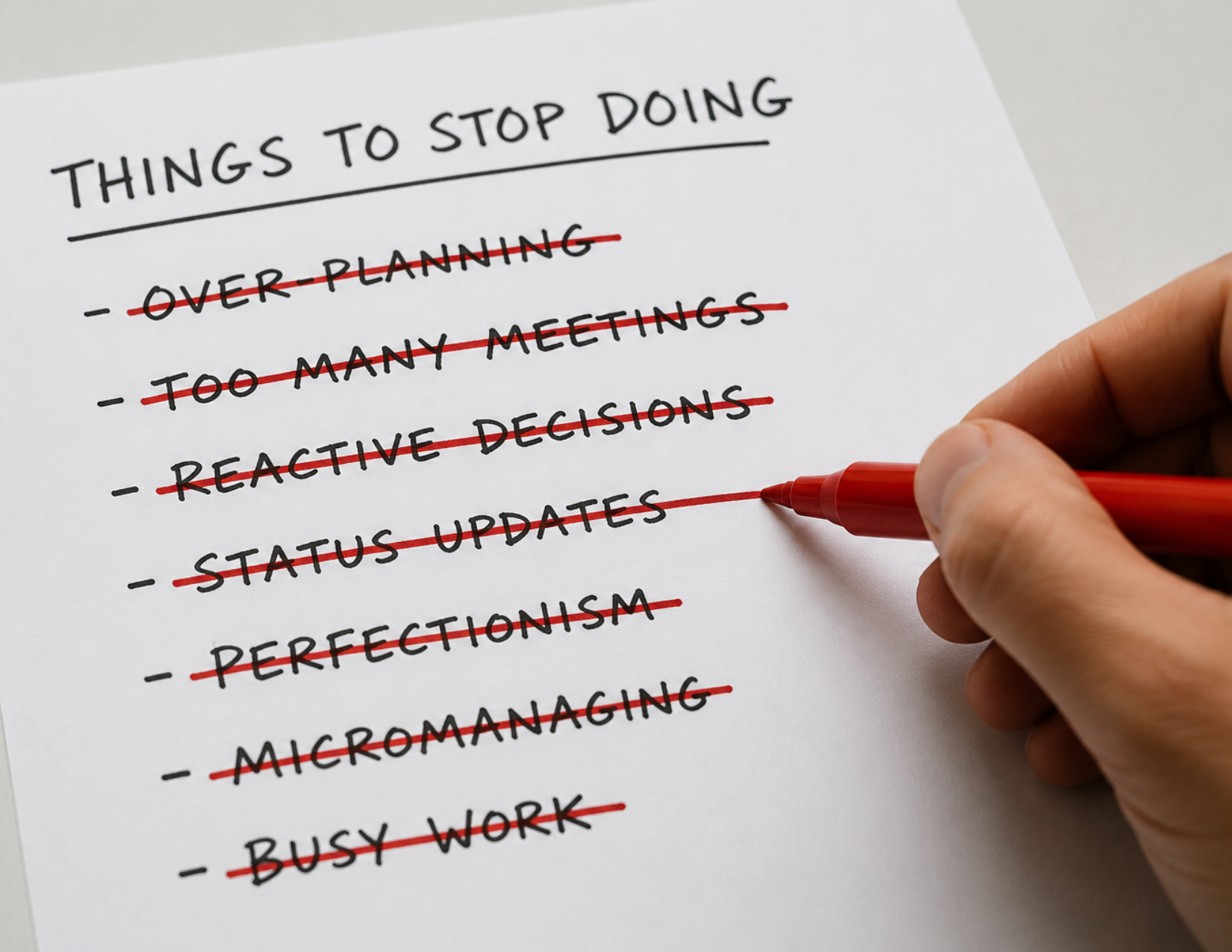
Most leadership conversations are about what to start. New initiative, new market, new product line, new process to fix the last process that didn't work. Almost nobody walks into a strategy session asking what the team should stop doing, even though that question is usually the one with the most leverage sitting untouched.
Brian Niccol's first moves as Starbucks' CEO are a useful, current example of what it looks like to ask that question seriously. Rather than launching a wave of new products to win back customers, his team announced plans to cut the menu by roughly 30% across both beverages and food, deliberately narrowing the offering to focus on the coffeehouse experience that had made the brand work in the first place. That's not a small trim. That's a sitting CEO publicly betting that subtraction, not addition, was the fastest path back to relevance.
The early signals from that strategy have been positive, and the bet itself says something leaders rarely act on: sometimes the most strategic thing you can do is take things off the list, not add to it.
This instinct runs directly counter to how most people think leadership works. There's a well-known story about Steve Jobs returning to a struggling Apple and reviewing the company's sprawling product line. Rather than trim it gradually, he eliminated all of it except four core products. The room reportedly erupted. People had built careers and arguments around the things he'd just removed in a single stroke.
Jobs understood the emotion completely and was unmoved by it anyway, because he understood something else more clearly: an organization trying to do ten things exceptionally cannot. It will do ten things adequately, and adequacy wasn't going to save a company on the brink.
Here's why this is so much harder than it sounds. Cutting isn't a math problem. It's a people problem. The initiatives, products, and processes on your Stop Doing list usually have someone's name attached to them, sometimes years of someone's working life. Asking a team to cut is asking them to separate their judgment about what has value from their attachment to what they personally built, which is one of the more emotionally demanding things you can ask of capable, invested people.
That's exactly why this question sits inside Simplify Aggressively, the second principle in the BrandTruth Alignment™ System. The goal isn't deciding whether something is good in isolation. Almost everything on the list is good in isolation. The real question is whether it's the right thing for this organization, right now, relative to everything else competing for the same limited time and energy.
That's a sharper, more honest conversation than most teams are used to having, and it's the one that actually produces a usable list instead of a wish list.
If you want to find your own answer, ask your team this directly: if a new leader walked in tomorrow with no history here, no sunk cost, and no loyalty to how things have always been done, what would they find baffling about what we still spend time on? Whatever surfaces from that question is probably your real Stop Doing list, waiting for someone to say it out loud.
Building a Stop Doing list that actually sticks, and holding the line once the pressure to bring everything back creeps in, is exactly the kind of work Leadership In Focus helps teams navigate. If you'd like to talk through what that could look like for your organization, reach out to us at contact@leadershipinfocus.ca.
