
You didn’t take on a job. You took on a Legacy.

A Thought Experiment
Close your eyes for a moment.
You're walking into the building on your first day. Not as an employee. As the person responsible for everything that happens inside it.
The name on the outside of that building — the one attached to every product that comes off the line, printed on every invoice, carried in every customer relationship — belongs to someone else. A founder. A family. A legacy that predates you by decades.
And they chose you.
Maybe you're the next generation of that family, stepping into a role you've been watching your whole life, feeling the weight of what was built and the pressure of what's expected. Maybe you're an outsider, a seasoned leader brought in precisely because the family recognized something they couldn't provide from the inside anymore.
Either way, the moment you walk through that door, you are the custodian of something that matters deeply to people who were here long before you arrived.
You didn't just take a job. You took on a legacy.
And somewhere in that building, the elephant is already waiting.
It Has Happened Before. To Leaders Far More Prepared Than They Felt.
Henry Ford II inherited one of the most iconic companies in the world, and nearly watched it collapse. By the time he took over in 1945, Ford Motor Company was losing $10 million a month. The culture his grandfather had built was fiercely loyal, deeply entrenched, and completely unprepared for what the business actually needed.
His move? He named the elephant. He brought in ten sharp young outsiders, the famous "Whiz Kids" as he called them, and challenged the old guard directly. It was uncomfortable. It was controversial. And, it worked.
Decades later, his successor Bill Ford faced a different version of the same moment. The culture had drifted again. Results were inconsistent. The brand promise wasn't being delivered by the organization behind it. Bill Ford did something that required enormous self-awareness: he recognized that what the company needed, he couldn't provide from the inside. So he handed the CEO role to Alan Mulally, a complete outsider from Boeing who had never worked a day in the auto industry.
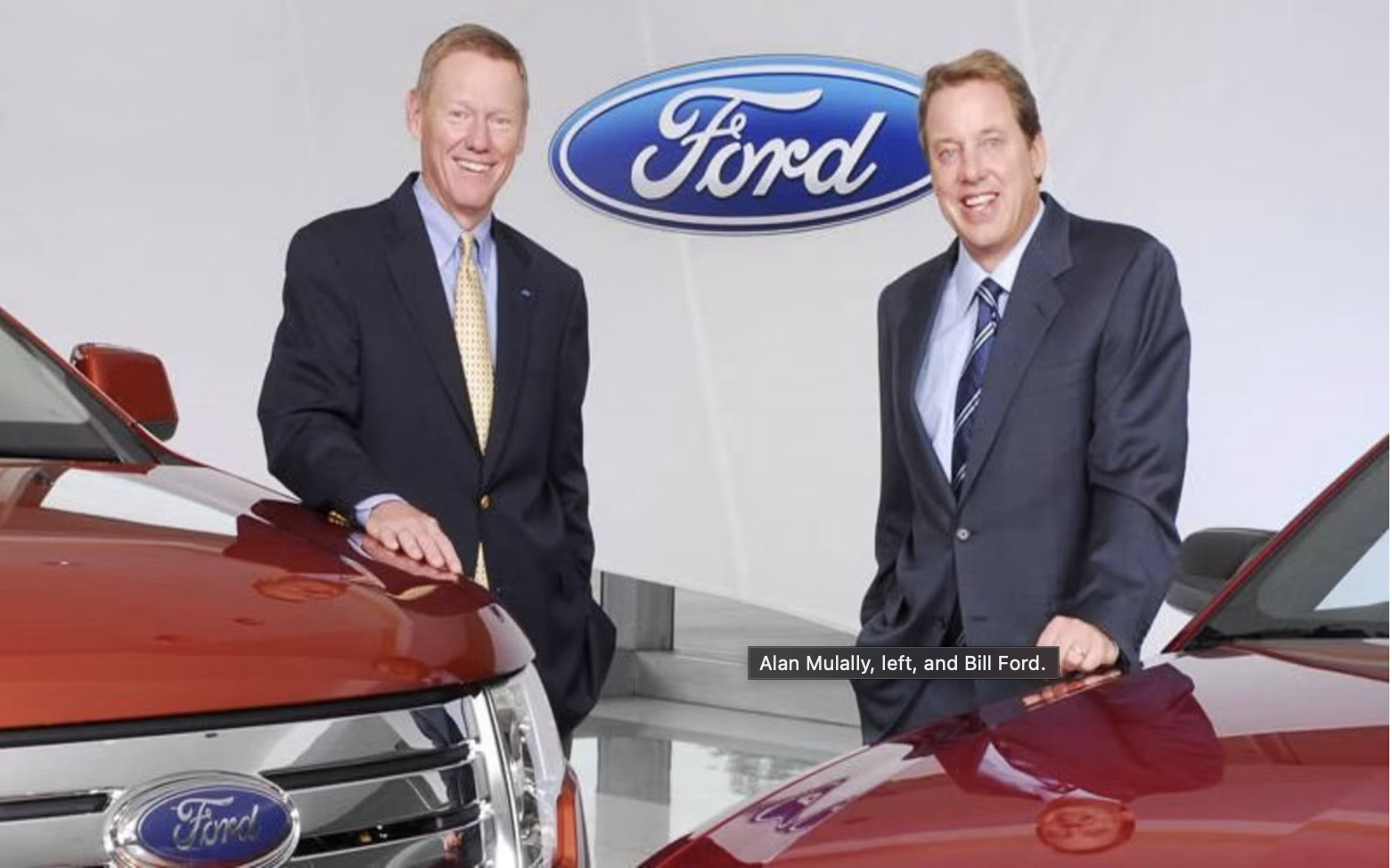
Mulally's first move wasn't a strategy overhaul. It was a cultural one.
He introduced a weekly Business Plan Review where every leader had to report real numbers: colour coded red, yellow, or green. The first week, every single leader showed green. Mulally looked around the room at a company losing billions of dollars and said, quietly: we're losing billions and everything is green?
The following week, one leader showed red. Mulally applauded him in front of the entire room.
That single moment changed the culture of Ford Motor Company. All it took to get the momentum started was one leader willing to name what was actually true, and reward someone else for doing the same.
That's the elephant being named. In real time.
Back to You
Whether you're the second generation stepping into your family's business, or a new leader inheriting something a founder spent decades building, you know the weight of that. The history in the walls. The loyalty people have to the way things are done. The quiet comparison that follows you into every room.
And you also know what you can see that maybe they couldn't anymore.
The market has shifted. The team needs something different. The culture that carried the company this far is starting to show its age. You've made some calls that haven't quite landed. The upward trajectory that once felt inevitable has started to flatten.
You can feel it. Something's off. People are holding back. Shifting in their seats. Not quite saying what they mean.
That feeling has a name.
It's the Elephant in the Business: the thing everyone in the room already knows but nobody has figured out how to say out loud yet. It’s not that they don't care. It’s just that: the stakes feel too high, the relationships too important, and the history is too heavy.
Three Things You Can Do Right Now
You don't have to wait for a crisis to name the elephant. Here's where to start:
Get honest about what's actually being said, and what isn't.
Walk the floor. Have the conversations that aren't on the calendar. Not to audit people, but to listen. The elephant lives in the gap between what gets said in the boardroom and what gets said in the break room. You need to know what's in both rooms.
Separate the legacy from the limitation.
Not everything inherited is a constraint. Some of it is your greatest asset. The work is learning to tell the difference: what deserves to be protected, what needs to evolve, and what needs to be retired with respect. That distinction is one of the hardest and most important calls you'll make.
Name one thing out loud that nobody else will.
You don't have to solve everything at once. But you do have to demonstrate that you're willing to say what's true. One honest observation, delivered with care and without blame, does more for your credibility as a leader than a hundred polished town halls. Mulally applauded the red. That's where your leadership begins.
What Comes Next
Here's what we know after working with founders, CEOs, and the leaders who follow them: the elephant doesn't go away on its own. It just gets more expensive to walk around.
At Leadership In Focus, we built the Elephant in the Business session for exactly this moment. A 90-minute diagnostic conversation designed to surface what's actually going on — between your brand, your culture, and your leadership — and give you the clarity and the language to start closing the gap.
A clear-eyed look at what the business is really dealing with, and the first honest move forward.
Because the name on that building deserves a future that's as strong as its past.
Big shoes are filled one step at a time. Let's figure out the next one together.
One More Thing
If this resonates — if you're sitting with some version of this right now, whether you inherited the business or built it yourself — our new white paper was written for exactly where you are.
Brand, Culture & Leadership as One Enterprise System draws on research from McKinsey, BCG, Gallup, Harvard, and Edelman to name what's happening inside most growing organizations right now, and gives leaders a practical framework for closing the gap between what the business says it stands for and how it actually operates.
It's free. It's substantive. And it might just name the thing you've been trying to put words to.
Download your free copy → HERE
