
What 750,000 Miles and a Moleskine Notebook Taught Me About Becoming a Leader
The Logbook
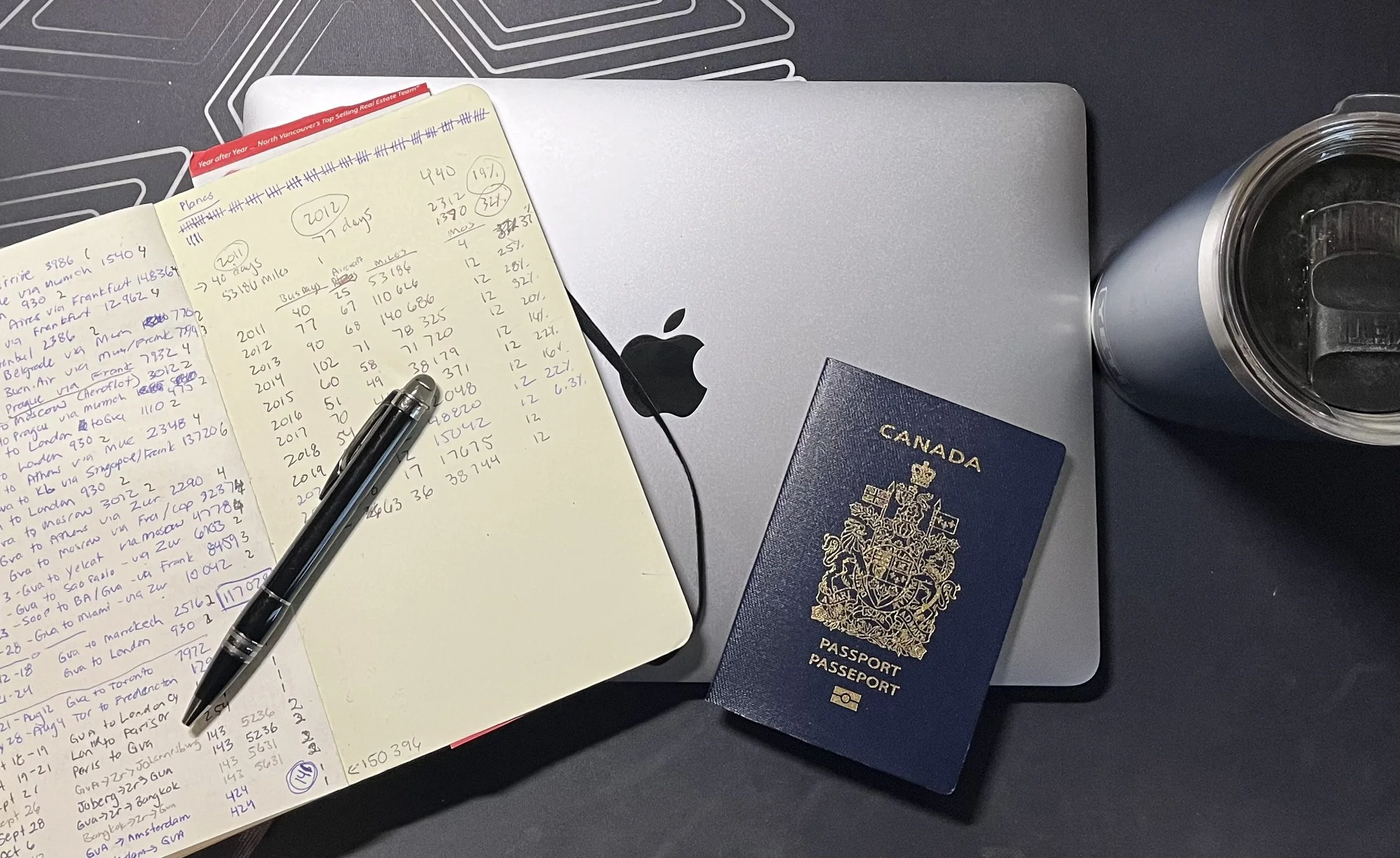
There is a Moleskine notebook sitting on my desk that I started in 2011.
Most of it is what you'd expect from someone who reads too much and thinks too loudly: notes and quotes from books, random ideas from projects, a section of course notes from an online program I took while living in Indonesia. The kind of notebook that looks chaotic from the outside and makes complete sense to the person who kept it.
But the most interesting section is near the back.
In 2011, when my family boarded our first flight to Switzerland to begin the next chapter of my career, I started logging every flight I took. Departure city. Transit points. Number of planes. Dates. Miles flown. A quiet, obsessive little record of everywhere the work took me.
Looking back at it now, what strikes me isn't the mileage. It's what each entry represents. Every flight was a project. Every destination was a chapter. And every chapter taught me something I couldn't have learned any other way.
I wish I had started this sooner. The twelve years before that first Switzerland flight — the travel, the experiences, the people — all of it undocumented. Including a big year in 2010 that took me to both Switzerland and Australia on back-to-back international assignments. Gone from the record, still vivid in the memory.
Here's what the logbook actually taught me.
Phase 1: Switzerland, 2011 — 53,000 miles in four months
Lesson: You don't have to be settled to be useful.
We had barely landed. My family was still figuring out where the grocery store was. I was still learning which cafeteria was which in our sprawling head office campus.
And I was already on planes.
London. Belgrade. Prague. Buenos Aires. Istanbul. Kuala Lumpur. Four of those trips were tied to a trade segmentation framework I was helping different markets adapt to their local realities. Two others were specific projects I'd been pulled into because of expertise I'd built over eleven years working in Canada; experience I didn't even fully realize had made me valuable until someone on the other side of the world needed it.
The lesson here is one most early-career leaders miss: you don't need to feel fully ready to contribute at a high level. The knowledge you've built in your current role is already useful somewhere else. Often, the people who need it most can see it before you can.
Phase 2: Global, 2012–2013 — 252,000 miles
Lesson: Expertise opens the first door. Curiosity opens every door after that.
By this point I had become a genuine authority on the trade segmentation framework. Markets sought me out. The work was meaningful and I was good at it.
But something more interesting was happening alongside it.
The scope was expanding. Change management in South Africa. Leadership presentations in Hong Kong, Dubai, Lausanne. Each new engagement pulled me slightly further from my original lane, and I was discovering that the further I stretched, the more I had to offer.
One of those trips, a fortuitous stop in Indonesia, quietly opened the door to the next chapter of my career entirely.
This is the phase that taught me the difference between being known for one thing and being ready for anything. Expertise earns your seat at the table. Curiosity is what keeps you there, and eventually moves you to a bigger table altogether.
Phase 3: Indonesia, 2014–2015 — 150,000 miles
Lesson: Scale forces you to lead through others, not around them.
This phase changed me more than any other.
I was now overseeing the deployment of trade marketing programs across a vast and complex geography. The scope was too large, the team too capable, and the budget too tight for me to operate the way I had before. I couldn't be everywhere. I couldn't touch everything. I had to trust people, and more importantly, I had to invest in them so that trust was actually warranted.
Developing people. Stretching resources. Aligning functions that didn't naturally speak the same language. This was the work. And the miles I logged weren't about showcasing presence, they were about making sure the right people had what they needed to execute without me standing over them.
The leaders who struggle at scale are usually the ones who haven't made peace with this shift. They mistake proximity for control and activity for leadership. Real leadership at scale is about multiplying your impact through the people around you, not managing the details yourself.
Phase 4: Canada, 2015–2017 — 100,000 miles
Lesson: Relationships are the strategy.
Coming home felt like a reset, and in many ways it was.
I was leading the Key Accounts team, with people spread coast to coast and major retail relationships to manage, negotiate, and grow. The work was different. The travel was different. Instead of traversing global time zones, I was crisscrossing provinces.
But the lesson was simple and consistent: the quality of the relationship determined the quality of the outcome. Every customer meeting, every joint business plan, every negotiated agreement; all of it traced back to trust that had been built long before anyone sat down at a table.
The same was true internally. Staying aligned with a geographically dispersed team required intentional investment in the relationship, not just the results. You can manage a number from a distance. You cannot lead a person that way.
Phase 5: Western Canada, 2017–2022 — nearly 200,000 miles (with a notable gap in 2020–2021 for reasons we all want to forget)
Lesson: Presence is a leadership tool. Use it with purpose.
This phase was about coverage, consistency, and clarity.
Four western provinces. A large field team. Corporate objectives that needed to be understood, owned, and executed at the ground level. My role in the travel wasn't ceremonial, it was functional. Clear the obstacles. Identify the talent. Ensure that what we said we were going to do was actually happening in the market.
The pandemic pause in 2020 and 2021 clarified something I hadn't fully articulated before: presence matters. Not because people can't function without you physically there, they clearly can. But because showing up in person signals something that a video call simply cannot replicate. It says: you are worth the trip. That message lands differently than any memo.
What the logbook actually is
It isn't a record of miles. It's a record of becoming.
Every entry represents a moment where I was asked to show up somewhere and contribute something, and came back different than I left. The destinations changed. The projects changed. The scale changed. But the through-line was always the same: grow into the moment you're in, and trust that what you're building is preparing you for the one that's coming.
Whatever your version of the logbook is — a journal, a resume, a folder of old performance reviews — I'd encourage you to look back at it through this lens.
Not what you accomplished. What you learned.
The miles are just how you got there.
