
Comfort Is Rarely Neutral. It Charges Interest.

When comfort becomes the quiet risk for leaders and business owners
This time of year often brings a low-grade sense of apprehension for business owners and leaders.
The clock resets.
Expectations reset.
Targets stretch beyond last year’s results.
On paper, the goals make sense.
In your gut, there’s a quiet question:
How are we actually going to get there this time?
And just beneath that:
Will my team really be able to carry this with me?
Because once you communicate new objectives, you’re not just sharing numbers — you’re asking people to believe there’s a real, achievable plan behind them.
The hard truth?
Many leaders don’t actually know if that plan exists yet.
The Scrappy Trap
In small and mid-sized businesses, scrappiness is often the reason you survived last year.
You pushed.
You improvised.
You carried more than your share.
You made it work.

But scrappiness has a downside.
When you’re constantly in execution mode, there’s very little space left for deliberate, long-term planning. And that’s where leaders can fall into a dangerous comfort zone:
Assuming your team “knows what to do”
Carrying the heaviest burden yourself
Trusting that effort alone will close the gap
Believing loyalty and goodwill will naturally translate into results
You might say:
“I told them the target. They know their roles.”
But an objective without a plan is just optimism dressed up as leadership.
Why “Just Do More” Rarely Works
Let’s make this concrete.
Say you did $900,000 in sales last year and set a goal of $1 million this year.
The default response is predictable:
“We’ll prospect more.”
“Sales needs to push harder.”
“Marketing just needs to generate more leads.”
But if nothing else changes, is an extra $100,000 actually realistic?

You may need to ask harder questions:
Do we need new product or service offerings?
Are our marketing channels still the right ones?
Does our messaging still resonate, or has it plateaued?
Are operational bottlenecks (inventory, supply, delivery) quietly holding us back?
Have tools, systems, and subscriptions piled up without scrutiny?
If your marketing has historically driven 5% growth, expecting 11% without changing the message, the channel mix, or the investment isn’t ambition — it’s hope.
And hope is not a strategy.
You Don’t Need to Carry This Alone (And You Shouldn’t)
If this list is making you uncomfortable, that’s a good sign.
Because the most important takeaway is this:
You do not need to solve this on your own.
In fact, trying to do so is often the very thing that limits growth.
The shift isn’t about working harder.
It’s about enlisting and empowering your team properly.
Here are three practical ways to do that.
1. Set Objectives That Go Beyond Revenue

Growth goals shouldn’t live only in sales numbers.
Include objectives around:
Cost savings
Process improvements
New service or product ideas
Operational efficiency
Customer experience
For example, a real estate firm might set goals around reducing transaction friction, improving referral conversion, or creating new client education offerings — not just “sell more homes.”
This spreads ownership and creates multiple ways to win.
2. Build the Plan With Your Team
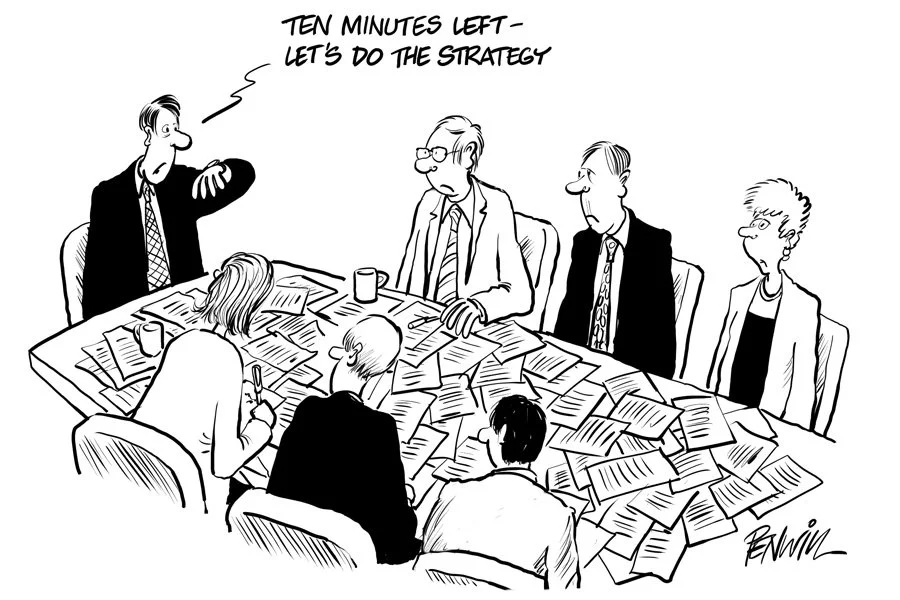
[Strategy time isn’t an afterthought]
Run a focused strategy workshop.
Bring your team into the process:
Conduct a simple SWOT analysis
Identify friction points in systems and processes
Brainstorm opportunities for improvement or growth
Then prioritize together:
1–3 short-term initiatives
1–3 medium-term initiatives
1–3 longer-term bets
Assign clear accountability.
Give people real ownership.
Let them lead.
People support what they help build.
3. Start Designing Your Own Replacement

[Succession is earned, not an inherited right - image from Succession]
This one feels counterintuitive, but it’s critical.
New CEOs are expected to think about succession almost immediately. Business owners and leaders should too.
Ask:
Who could take more responsibility with the right support?
Where am I still the bottleneck?
What decisions am I holding onto out of habit, not necessity?
Developing your talent pipeline does two things:
It shares the burden
It increases the long-term value of the business
If you’re an owner, it strengthens your eventual exit.
If you’re a leader, it demonstrates readiness for the next level.
The Real Work of Leadership
It’s one thing to set a goal and hope your team gets you there.
It’s another to:
Create clarity
Define strategy
Set expectations
Build accountability
And then trust people with real ownership
Most people want their leaders to succeed.
But they need the tools, context, and authority to actually help.
When you involve your team in the vision, equip them with a plan, and give them room to lead, you’re offering something far more meaningful than a “stable job.”
You’re offering growth.
For them.
And for you.
