
Why Do Our Values Feel Meaningless?
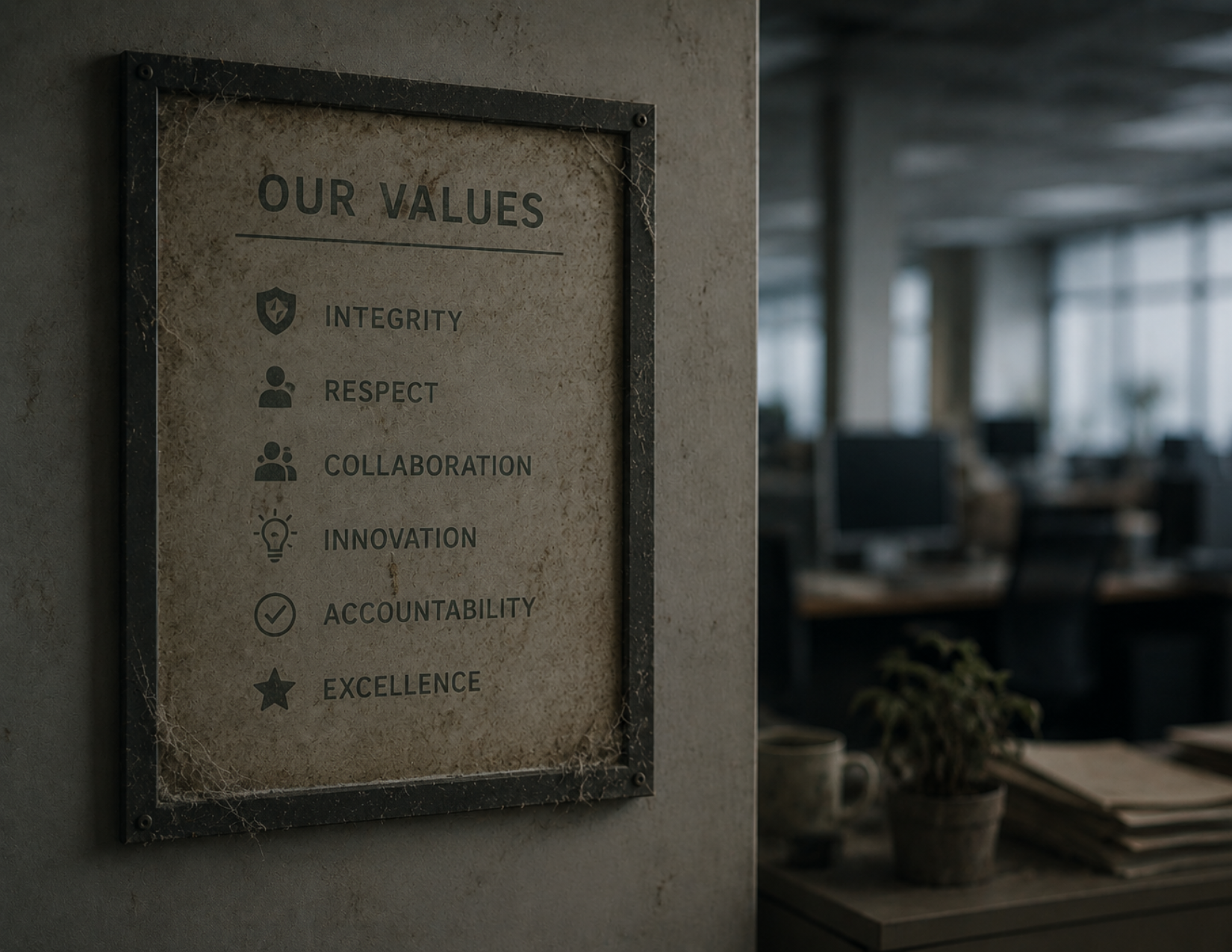
Integrity. Service. Excellence. Quality. People first. If your organization's values statement could be copy-pasted onto a competitor's website without anyone noticing the difference, that's the predictable result of values that were written to sound right rather than to mean anything specific.
Gallup research has found that only 27% of employees actually believe in their company's stated values, and just 23% say those values are practical or fitting enough to apply in their day-to-day work. A more recent UK survey found that more than half of employees can't even recite their organization's stated vision, and nearly one in five say the values don't reflect what the company is actually like to work for.
These aren't communication failures that better posters, a ping-pong table, or another all-hands meeting would fix. They're a clear sign that the values were never built to govern anything in the first place.
Boeing offers a stark example of what happens when this gap becomes consequential rather than merely cosmetic. Following the 737 MAX crashes and the 2024 door-plug incident, an FAA-authorized expert panel reviewed the company's safety culture and found what it called a lack of awareness of safety-related metrics at every level of the organization, along with an inadequate and confusing implementation of the basic components of a positive safety culture. An internal Boeing survey around the same period found that more than half of employees felt schedule pressure had caused their team to lower its standards.
Boeing's official values had always included safety as a stated priority. What the data revealed was a company where schedule pressure was quietly overriding that stated priority in real decisions, every day, at every level, while the language on the wall stayed exactly the same.
That's the mechanism behind values feeling meaningless almost everywhere they do. The words meant something when they were written. They became false through accumulation, one schedule pressure, one cost pressure, one reasonable-sounding compromise at a time, until the gap between what's said and what's actually rewarded becomes the real culture, and the values statement becomes décor.
Here's the test worth applying to your own organization: pull up your stated values right now and ask, honestly, whether a frustrated former employee could read them out loud as a punchline. If the answer makes you wince even slightly, the problem is that the values were never specific enough to actually constrain a decision, which means they were never real values to begin with.
Real identity tells your people exactly what to do when a customer pushes back, when a deadline gets tight, when cutting a corner would be easy and nobody senior is in the room. If your values can't do that, they're not failing. They were never built to succeed.
This is the work at the centre of the BrandTruth Alignment™ System: surfacing the identity an organization is actually living, not the one it has been claiming, and making that real identity specific enough to govern decisions daily when nobody senior is watching.
Getting honest about the gap between your stated values and your lived ones is some of the most important diagnostic work a leadership team can do. At Leadership In Focus, that's exactly where we help organizations start.
Reach out to us at contact@leadershipinfocus.ca to talk through what that could look like for yours.
