
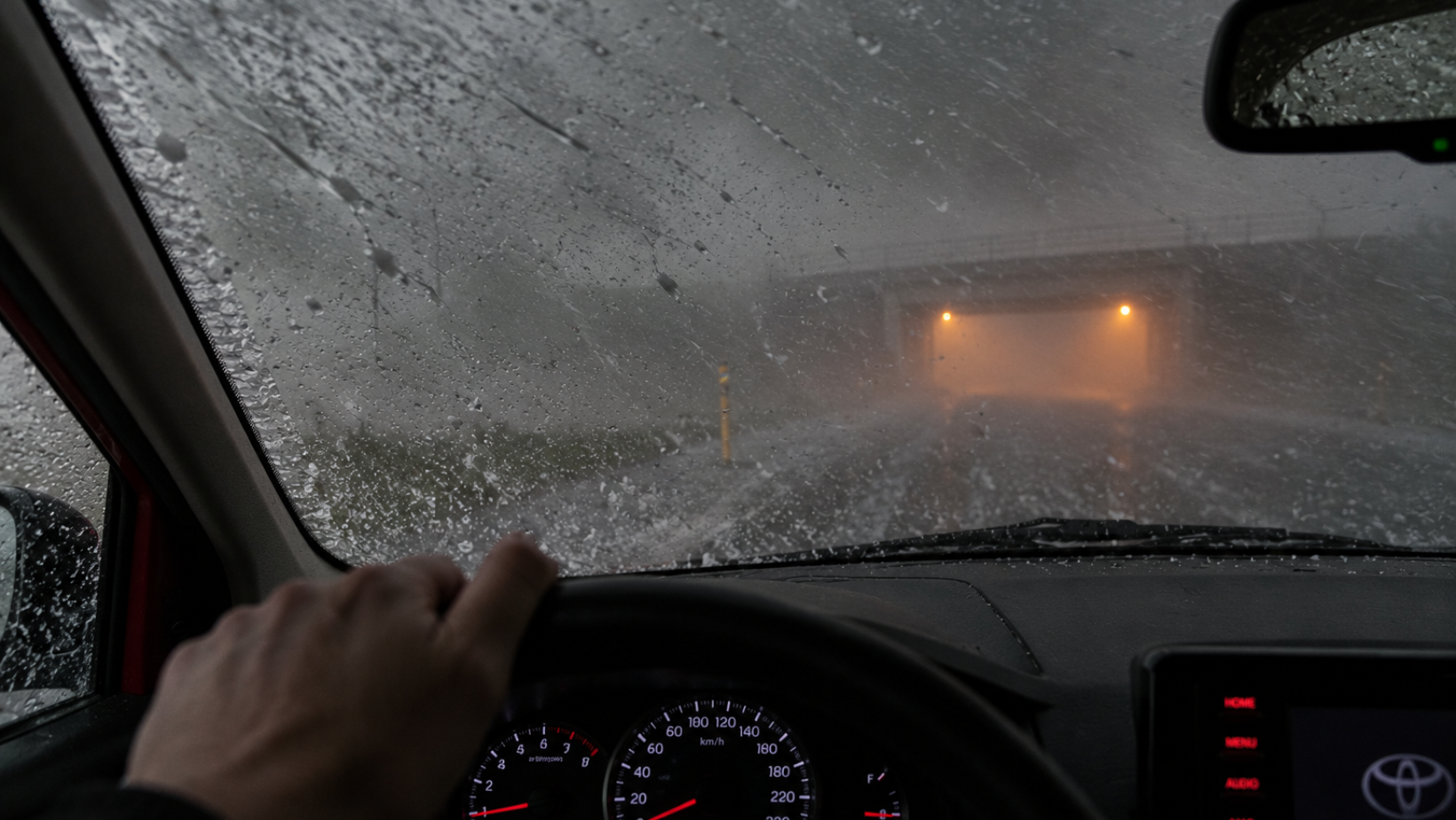
Stuck in a Tornado
A few years ago I was driving from Saskatoon to Regina in a small rental car.
The prairie sky darkened in that particular way that tells you something serious is coming. The rains started, then intensified.
Thunder.
Lightning.
My grip on the wheel tightened as I watched the GPS and counted the minutes to Regina, to shelter, to somewhere that wasn't completely exposed on a flat stretch of highway with nowhere to go.
Then the visibility dropped. Then the hail started. Within minutes I could see maybe five to ten feet in front of me. The hail was moving sideways. My car was rocking, possibly moving, from the force of the wind. I pulled onto the shoulder and sat there, alone, listening to the sound of what I can only describe as something I had never experienced before and hope never to experience again.
Then it passed. Just like that.
The radio mentioned tornadoes in the area. I'm fairly certain I know what that was.
The Rope in the Storm
I came across a story recently about the early pioneers and farmers of the midwest. In the fierce winter storms that swept across the plains, the simple act of walking from the farmhouse to the barn to feed the livestock could become genuinely life-threatening. The blizzards were disorienting in a way that made it possible to lose your bearings completely just steps from your own door.
So the farmers did something practical and elegant. They tied a rope between the porch and the barn. Something to hold onto when you couldn't see where you were going.
It kept them on course. It got them there and brought them back.
The Leadership Rope
In our personal lives and in our leadership, storms arrive. They don't announce themselves with much warning, and they rarely wait for a convenient time.
Personal crisis.
Professional upheaval.
A stretch where the path forward is genuinely unclear and the pressure of not knowing is consuming most of your available energy.
In these moments, vision gets limited. The ability to see through to the other side — to know when the weather clears, or where — becomes almost impossible.
What we need in those moments is a rope. Something to hold onto that keeps us oriented and moving in the right direction while we can't fully see where we're going.
The rope I've come to believe in has four strands, braided together. Each one makes the others stronger.
Strand 1: Face Reality
Every meaningful turnaround, personal or professional, begins with the same uncomfortable act: seeing things as they actually are. Not as you wish they were. Not as you've been reassuring others they are.
This is harder than it sounds. We are all, to some degree, the unreliable narrator of our own lives. We explain away the warning signs. We manage the narrative. We stay busy precisely because slowing down would mean having to look at what's actually happening.
Facing reality is not about self-criticism. It's about the courage to see clearly, and to let that clear seeing be the starting point for everything else.
If you’re in the storm, ask yourself: If your closest friend described your situation honestly right now, without protecting your feelings, what would they say? What have you been managing around rather than facing directly?
Strand 2: Eliminate Complexity
Most people who feel stuck in a storm are not under-resourced. They are over-committed.
Too many obligations. Too many identities to maintain. Too many relationships that take more than they give. Too many decisions consuming energy that should be going somewhere meaningful.
Personal complexity almost always arrives disguised as opportunity, obligation, or loyalty. The discipline is learning to distinguish between what is genuinely yours to carry and what you have been carrying by default, and finding the courage to set the second category down.
If you’re in the storm, ask yourself: If you could stop doing three things tomorrow — obligations, commitments, habits — what would they be? What is the storm noise in your life drowning out?
Strand 3: True Identity
Most people don't have a clear answer to the question "who are you?" that exists independently of what they do.
For a long time, that feels fine. The role provides the identity, the identity provides the direction, and the direction provides momentum. Until the role changes, ends, or stops being what you thought it was.
The disorientation that follows a major professional or personal storm is almost always, at its core, an identity question. The kind that shows up as a vague sense that you no longer know what you're optimizing for, or whether the things you've been working toward are actually the things you want.
Reclaiming identity isn't reinvention, it’s excavation. Getting beneath the layers of role, reputation, and performed self to find what is actually and specifically yours.
If you’re in the storm, ask yourself: Who were you before you became the version of yourself the world currently expects? Complete this sentence honestly, not aspirationally: "I am someone who ___." Now: "I am not someone who ___." Do your current choices match those answers?
Strand 4: Reconnect to What Matters
Periods of struggle have a predictable effect on the things that matter most. We withdraw. We become less available to the people who love us. We stop doing the things that replenish us because they feel indulgent when things are hard.
The irony is that the things we most deprive ourselves of during difficult periods — meaningful connection, purpose, experiences that remind us why we are doing this — are precisely the things that would accelerate the recovery.
Reconnecting is not a reward for completing the turnaround. It is part of the turnaround.
If you’re in the storm, ask yourself: Who are the people who know you best and love you most regardless of your professional performance? When did you last give them your full, undistracted attention? What would you start doing again if you stopped waiting until things were better?
The Other Side of the Storm
I made it to Regina. The car was unscathed. My nerves took considerably longer to recover.
When the storm passes, the relief is immediate. But the stress that accumulated during it takes time to leave the body. The farmers who tied the rope between the porch and the barn still had to weather the storm. The rope didn't protect them from the wind. It just made sure they didn't lose their way in it.
That's what these four strands are for.
Not to keep the storms from coming. Not to make the hard stretches easier than they are. Just to give you something to hold onto when the visibility drops and you can't quite see where you're going.
Hold the rope. Keep moving. The weather changes.
